Liao army
Demi-Gods and Semi-DevilsThe Liao army combines formidable command and battlefield coordination with a frontier economy sustained by raids on neighboring populations. Its strength is visible in rapid mobilization, organized formations, and disciplined signals; its fragility appears when the families of its soldiers are taken hostage, and its violence becomes a moral crisis for Xiao Feng when he encounters Song captives being carried away by Liao troops.
Command and Mobilization
The army’s command structure is revealed when an urgent bugle call reaches YeLu HongJi’s hunting encampment. The signal is relayed from station to station, each call arriving closer until it stops at the imperial tent. Though officers and soldiers had been feasting, the call brings the gathering to silence. HongJi announces a rebellion in the capital and orders an immediate return. A single command to break camp passes through the ranks and expands from one order to many, while units begin moving south in sequence.
The dispatch shows coordination at more than one level. The advance party leaves first, followed by the left and right vanguards and other formations. Guards dismantle the encampment and load its supplies onto carts as the main force prepares to move. Lanterns mark the banners during the night march, while the troops travel with little sound beyond the horses. Xiao Feng, impressed by this order, recognizes that the army’s discipline and numbers make it a formidable instrument of imperial authority.
Formation and Battlefield Tactics
When HongJi’s force learns that his uncle YeLu ZhongYuan and cousin YeLu NieLuGu are advancing against him, the emperor personally leads troops to meet them. He promises promotion and rewards after the crisis, dons golden armor, and rides at the head of three units. Xiao Feng follows beside him as a personal bodyguard, while the Flying Bear troops protect AhZi at the rear. The emperor’s presence raises the soldiers’ confidence, and the force of 100,000 advances in four divisions, with a smaller squad moving along the flanks.
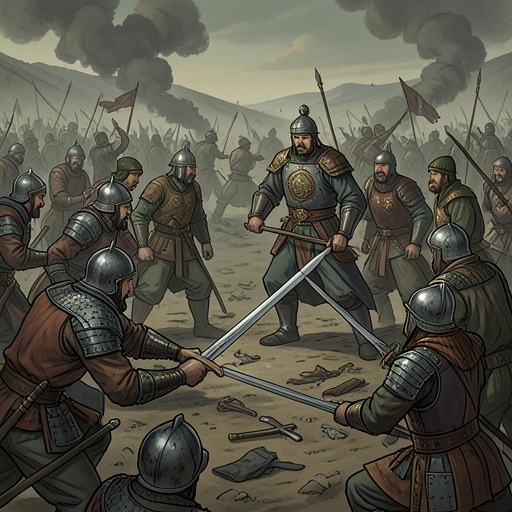
The army’s tactics reflect the importance of cavalry and terrain in Khitan warfare. HongJi explains that on level ground, horse strength enables a charge through enemy lines. But as the opposing forces approach, the Liao army sees that it is outnumbered five to one. HongJi orders a defensive stockade: soldiers hammer tent poles into the earth, spread canvas, and add abatis around the perimeter. About 10,000 archers take position within the enclosure. Drums coordinate the start of battle; when the enemy charges, the Liao general halts the drumming and the archers release a massed volley. The first wave falls, but later attackers press forward behind the fallen horses and return fire with shields.
The troops’ effectiveness depends not only on their weapons but on coordinated command and morale. HongJi initially appears fearful when he sees the scale of the rebel force, yet once the battle begins he takes a position on high ground and directs the defense. His soldiers respond to his visible leadership with cries of loyalty, briefly unsettling the attackers. The army is thus presented as a force whose discipline can be strengthened by the ruler’s personal authority, even when numbers and circumstances are against it.
The Rebellion and the Army’s Vulnerability
The conflict has roots in the Liao succession. YeLu LongXu had designated his elder son YeLu ZongZhen to inherit the throne, although the empress favored her younger son, YeLu ZhongYuan. ZhongYuan chose to support his brother rather than take the throne, and ZongZhen later named him royal emperor brother and heir. After ZongZhen’s death, however, the throne passed to his son HongJi. HongJi tried to reconcile the succession with his uncle’s power by granting him high status and command of the army, while making ZhongYuan’s son NieLuGu Prince of Chu and Lord of the Southern Chancellery. That arrangement left the emperor’s uncle and cousin in positions of extraordinary military influence—and made their rebellion a threat from within the ruling order.
HongJi’s army is nearly broken not simply by battlefield losses but by a policy intended to secure its loyalty. He had allowed soldiers’ families to live in the capital, both to reward the troops and to keep them under imperial oversight while the army was away. When the rebels seize those families, they bring captives before the stockade and threaten to kill them unless the soldiers surrender. The hostages include men, women, children, and elderly people; although the families number more than 200,000, about 30,000 are brought forward, and some are not even related to the troops being addressed.
The threat turns military allegiance into a conflict between loyalty to the ruler and responsibility toward kin. One soldier breaks from the stockade to reach his mother; others follow, despite efforts by HongJi’s trusted generals to stop them. Hundreds leave, then thousands, until roughly 60,000 to 70,000 of the original 150,000 troops have crossed to the rebel side. HongJi recognizes that the position cannot be recovered and orders a retreat toward the mountains in the northwest. The remaining force, about 80,000, escapes while the rebels are delayed by the civilians filling the battlefield. It reaches a slope at dusk, fortifies the high ground, and repels an immediate assault before the rebels establish a camp below.
Raiding and the Border Economy
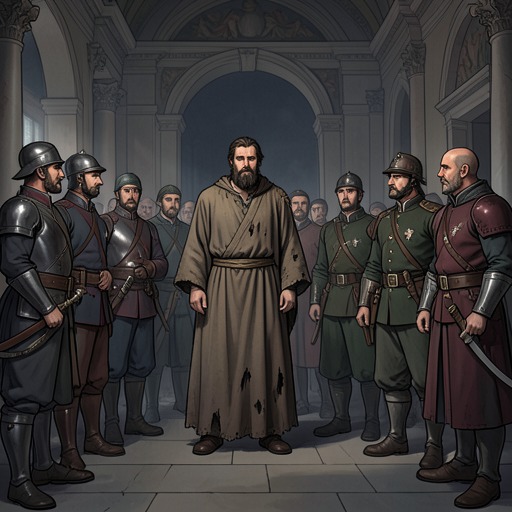
The army’s power is also sustained by raiding across the frontier. Xiao Feng encounters about 800 Liao soldiers returning with captured goods and between 700 and 800 Song civilians, most of them young women. The captain describes the expedition as the unit’s turn to raid, and the soldiers offer their captives and valuables to Xiao Feng as a mark of respect for his rank. The scene places official command beside the army’s material practice: the troops expect to provision themselves through the seizure of people and property.
The account describes this policy as a system rather than an isolated abuse. The Liao government does not supply its troops with rations or pay them wages, so soldiers obtain necessities by raiding Great Song, Western Xia, Jurchen, Korea, and other neighboring lands. Liao raids are called Beating the Grass Valley; retaliatory Song raids are called Beating the Standing Valley. Civilians near the border bear the consequences of this reciprocal violence, living with the threat of capture and uncertain survival. The captives Xiao Feng sees are poor people, unlikely to have the gold or silk needed to buy their release.
Xiao Feng’s response exposes the distance between the army’s customs and his own judgment. He recalls that he had seen Song soldiers capture Khitan civilians at Yanmen Pass and now sees Liao troops doing the same to Song civilians. The opposing labels—Khitan and Song—do not alter the captives’ shared humanity in his reflection. He releases the prisoners and advises them to move away from the frontier, while acknowledging that he may not be able to protect them in the future. The episode makes the Liao army both a governing force and a participant in a cycle of raids that subjects border populations to repeated danger.
The Army Across Ethnic and Political Lines
The army’s encounters with other peoples complicate any simple division between allies and enemies. At a Jurchen gathering, Xiao Feng learns that the Jurchen and Khitan are at war, yet both communities admire capable fighters. When Jurchen hunters and Khitan riders clash, the Khitans call for the Jurchen to be shot at once. Xiao Feng, himself Khitan, intervenes to prevent deaths: he dismounts two Khitan attackers without killing them and later shoots four more in the shoulder or foot. He does not know at first which side to support, and his actions show how ethnic belonging and immediate moral choice pull in different directions.
That tension recurs when Xiao Feng, now a Liao official, faces the consequences of the army’s raids. His authority gives him the power to release the Song captives, but the larger system that produces such expeditions remains in place. The Liao army is therefore defined not only by its capacity to march, fight, and obey commands, but also by the political arrangements and frontier practices through which it maintains itself—and by the civilians and family ties that can expose the limits of its control.